
Administrative Closure & Termination in Immigration Court
Date of Information: 02/21/2026
Check back soon; we update these materials frequently.

Understanding the Difference — and Why It Matters
Immigration court proceedings can be paused or ended in different ways. Two of the most commonly misunderstood mechanisms are administrative closure and termination.
Both result in the suspension of active immigration court proceedings. Both can stop forward movement toward a removal order. But they are not interchangeable. They serve different purposes, are governed by different regulatory standards, and carry different strategic consequences.
Choosing the wrong one can cost leverage, delay relief, or create unnecessary risk. Understanding the scope and limits of each tool is critical.
Administrative Closure
What It Is
Administrative closure is now expressly codified in 8 C.F.R. § 1003.18(c) (immigration judges) and § 1003.1(l) (Board of Immigration Appeals). The regulation defines administrative closure as the temporary suspension of a case. It removes the case from the immigration court’s active calendar (or the Board’s docket) until it is recalendared.
Administrative closure does not terminate proceedings. It does not result in a final order. Either party may later move to recalendar the case.
Authority and Standard
Under 8 C.F.R. § 1003.18(c)(1), an immigration judge may administratively close a case in the exercise of discretion upon motion of a party, after applying the regulatory standard. The standard is now codified in § 1003.18(c)(3). It provides:
Joint or non-opposed motions must be granted unless the immigration judge articulates unusual, clearly identified, and supported reasons for denial.
In contested cases, the immigration judge must consider the totality of the circumstances.
No single factor is dispositive.
Administrative closure may be granted even over objection.
The regulation lists specific factors the judge must consider, including:
The reason administrative closure is sought
The basis for any opposition
Whether closure is required for DHS adjudication of a petition or application
Likelihood of success on collateral relief
Anticipated duration of closure
Responsibility for delay
Ultimate anticipated outcome
ICE detention status
Importantly, the regulation clarifies that a pending petition or application outside of immigration court is not required for administrative closure. That is a significant codified clarification.
Recalendaring
Under § 1003.18(c)(2), either party may move to recalendar. The judge applies a parallel totality-of-the-circumstances analysis. The regulation also identifies specific recalendaring factors, including elapsed time and the status of any collateral filing.
What Administrative Closure Does — and Does Not — Do
Administrative closure:
Pauses proceedings
Stops hearings from being scheduled
Removes the case from the active docket
Preserves jurisdiction
It does not:
Dismiss the charges
Eliminate removability
Provide lawful status
Prevent DHS from later recalendaring
It is a docket-management tool, not substantive relief.
Castro-Tum, Cruz-Valdez, and Circuit Sensitivity
Administrative closure has experienced a volatile history. Matter of Avetisyan (BIA 2012) recognized broad administrative closure authority grounded in regulatory powers under 8 C.F.R. §§ 1003.10(b) and 1003.1(d). Matter of Castro-Tum (A.G. 2018) sharply curtailed that authority. Matter of Cruz-Valdez (A.G. 2021) expressly overruled Castro-Tum and reinstated Avetisyan. Separately, the Fourth Circuit in Zuniga Romero v. Barr held that immigration judges possess regulatory authority to administratively close cases.
As of 2026, administrative closure is now codified in regulation. That materially changes the legal landscape. The authority is no longer resting solely on interpretive precedent — it is embedded in the text of 8 C.F.R. Part 1003.
That does not mean the law is immune from future regulatory revision. But it does mean:
Requests for administrative closure are not frivolous.
The authority exists in black-letter regulation.
Immigration judges are bound by the regulatory standard.
However, venue still matters. Judicial attitudes toward closure may vary, particularly in circuits that historically took restrictive views prior to codification. Practitioners should understand local court practice, DHS posture, and circuit culture. Administrative closure now sits on firmer regulatory footing than it did during the Castro-Tum period — but immigration law remains politically dynamic.
Termination
Termination is governed by 8 C.F.R. § 1003.18(d) for immigration judges and § 1003.1(m) for the Board. Termination ends proceedings. Unlike administrative closure, termination removes the case from the court entirely. The government must reinitiate proceedings (if legally permitted) by issuing a new charging document.
Mandatory Termination
Under § 1003.18(d)(1)(i), immigration judges must terminate removal proceedings where at least one regulatory condition is met, including:
No charge of removability can be sustained
The noncitizen has obtained U.S. citizenship
The noncitizen has obtained lawful permanent resident status, refugee status, asylee status, or certain S/T/U nonimmigrant status after proceedings began
Termination is required by law
The parties jointly move to terminate (absent unusual, clearly identified reasons to deny)
Discretionary Termination
Under § 1003.18(d)(1)(ii), an immigration judge may terminate in removal proceedings if specific regulatory criteria are satisfied. These include:
The noncitizen is prima facie eligible for naturalization, relief, or lawful status and USCIS has jurisdiction
The noncitizen is a beneficiary of TPS, deferred action, or Deferred Enforced Departure
USCIS has granted a provisional unlawful presence waiver
Comparable circumstances make termination necessary or appropriate
However, the regulation now imposes important limitations:
Immigration judges may not terminate for purely humanitarian reasons unless DHS consents or affirmatively indicates non-opposition.
Judges may not terminate to allow the pursuit of asylum before USCIS unless the applicant is an unaccompanied child under INA § 208(b)(3)(C).
Nothing authorizes termination where prohibited by another regulation.
These are meaningful constraints. Termination is no longer an open-ended discretionary mechanism.
Administrative Closure vs. Termination: Practical Differences
These tools accomplish different objectives. They should not be treated as substitutes.
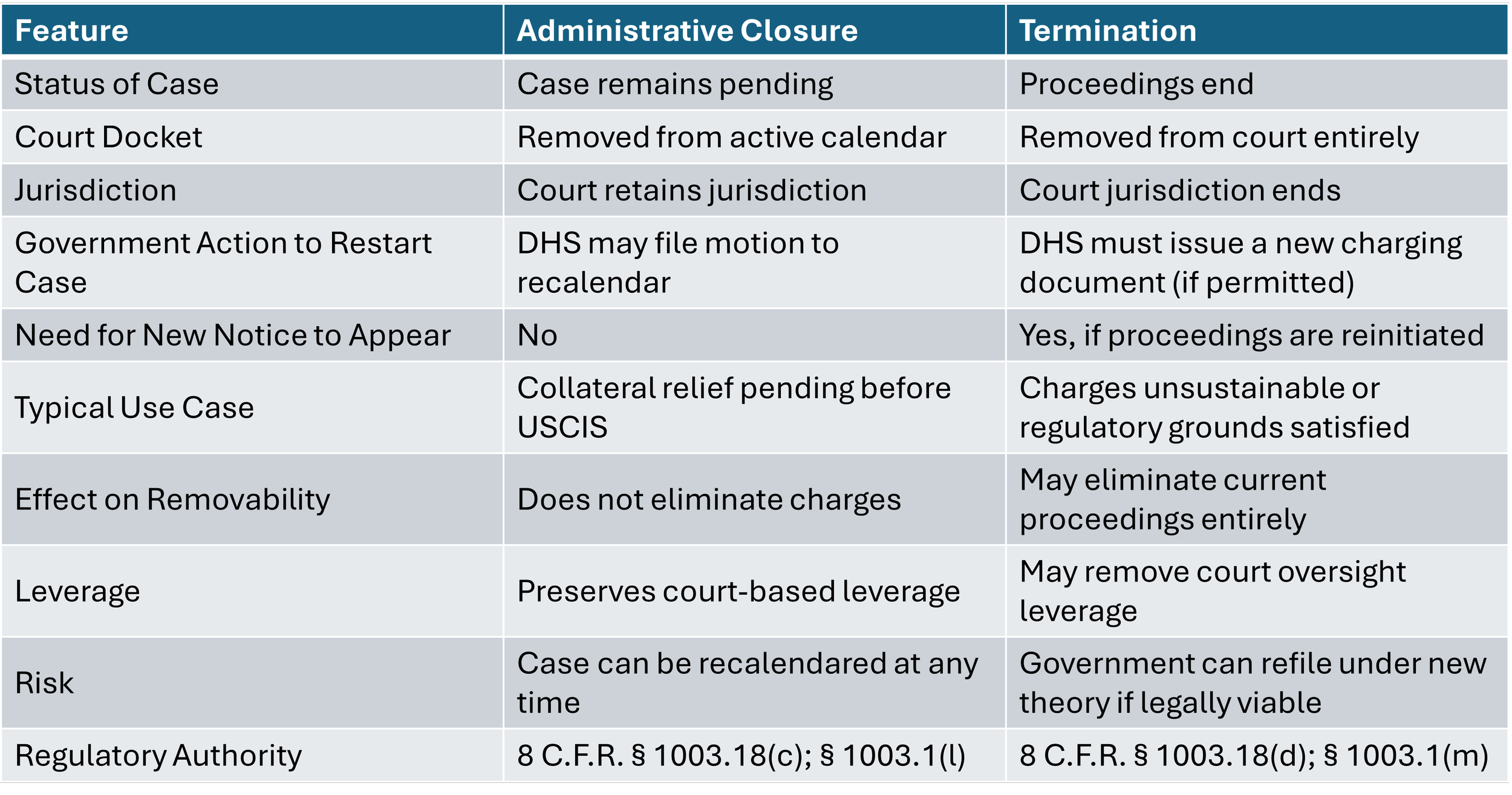
Strategic Decision Matrix: When to Seek Administrative Closure vs. Termination
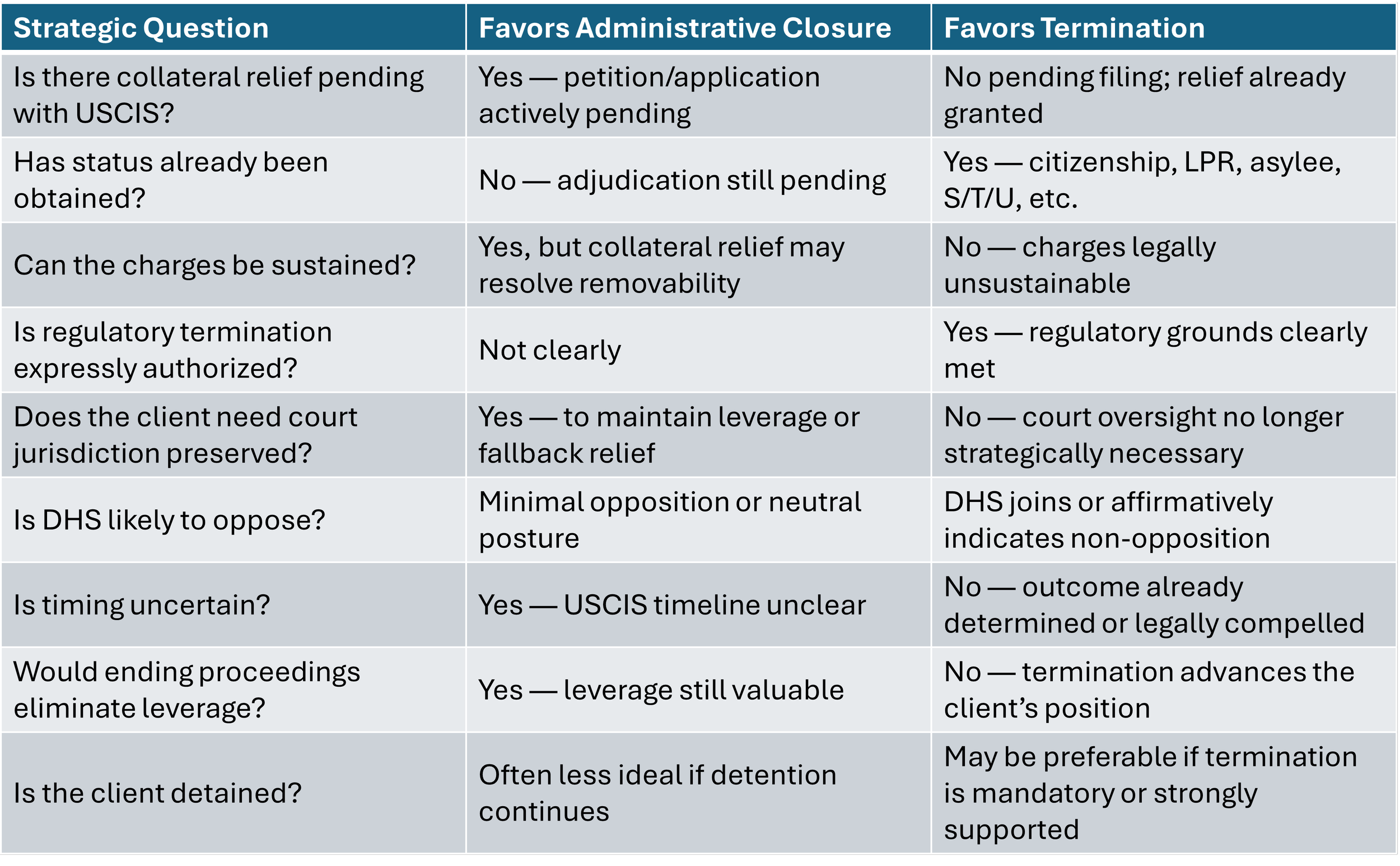
Practical Application Guide
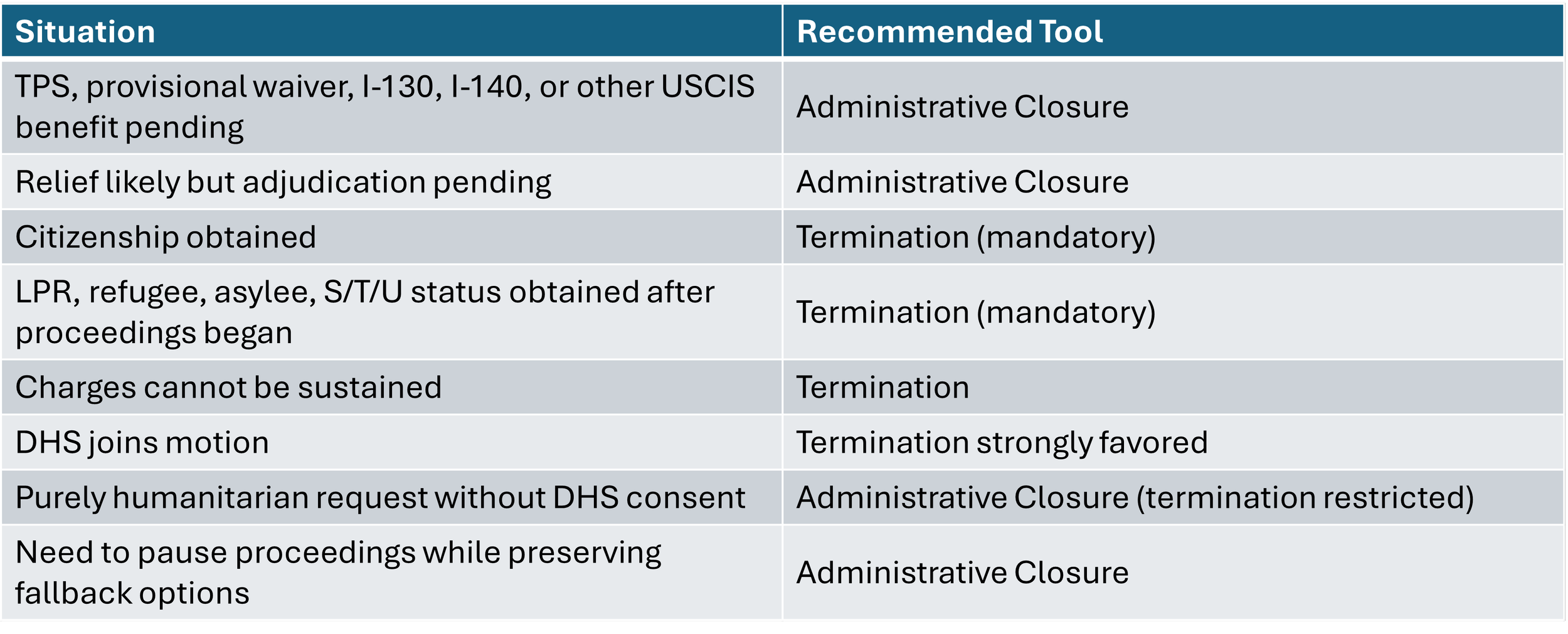
Choose the Right Strategy Before You File
Your removal case is not the place for procedural guesswork.
Administrative closure and termination are powerful tools — but they serve different purposes and carry different risks. Choosing the wrong strategy can cost leverage, delay relief, or create avoidable complications.
If you are in immigration court and need a clear, regulation-grounded strategy, schedule a consultation to evaluate the right move for your case.
Frequently Asked Questions About Administrative Closure and Termination in Immigration Court
What is administrative closure in immigration court?
Administrative closure is the temporary suspension of removal proceedings. The case is removed from the immigration court’s active calendar but remains pending. Either party may later file a motion to recalendar the case and restart proceedings.
What is termination of removal proceedings?
Termination ends the removal case. The immigration court no longer has jurisdiction over the matter. If the government wishes to pursue removal again, it generally must issue a new charging document, assuming it is legally permitted to do so.
What is the difference between administrative closure and termination?
Administrative closure pauses a case; termination ends it. Closure preserves the existing case and allows it to be restarted. Termination eliminates the current proceedings altogether. The strategic consequences are different, and the two mechanisms are not interchangeable.
Does administrative closure give me legal status?
No. Administrative closure does not provide lawful status, work authorization, or relief from removal. It simply removes the case from the court’s active calendar while collateral matters are resolved.
Can DHS restart my case after administrative closure?
Yes. Either DHS or the respondent may file a motion to recalendar. If granted, the case returns to the court’s active docket and proceeds toward resolution.
When is termination mandatory?
Termination is required in certain regulatory circumstances, such as when no charge of removability can be sustained, when the respondent has obtained U.S. citizenship, or when other specific regulatory conditions are met under 8 C.F.R. Part 1003.
Can a case be terminated because I have TPS?
Temporary Protected Status may support discretionary termination under current regulations, depending on the circumstances. However, the analysis is fact-specific and depends on regulatory criteria and DHS posture.
Is administrative closure still allowed after Matter of Castro-Tum?
Yes. Administrative closure authority is now expressly codified in 8 C.F.R. § 1003.18 and § 1003.1. Matter of Castro-Tum was overruled by Matter of Cruz-Valdez, and the authority has since been incorporated into regulation.
Can an immigration judge deny a motion for administrative closure?
Yes. If the motion is opposed, the judge applies a totality-of-the-circumstances standard and weighs regulatory factors such as likelihood of success on collateral relief, anticipated duration, and detention status.
Is termination better than administrative closure?
Not necessarily. Termination provides greater finality but may eliminate strategic leverage or shift jurisdiction in ways that are not advantageous. Administrative closure may be preferable when collateral relief is pending and jurisdiction should be preserved.
Can I pursue a USCIS petition while in removal proceedings?
Often yes, but jurisdictional rules are complex. In some cases, administrative closure or termination may be necessary to allow USCIS to adjudicate a petition. The proper procedural vehicle depends on the type of relief and the regulatory framework.
Should I file a motion for administrative closure or termination without an attorney?
Removal proceedings are adversarial litigation. Motions for administrative closure or termination require regulatory analysis, strategic judgment, and awareness of local court practice. Filing the wrong motion at the wrong time can create unintended consequences.
Other Helpful Resources:
See Also:
CIL Guide to the Circumvention of Lawful Pathways Rule
Charles International Law’s research guides are always free, but if you find them helpful, please consider a donation or gratuity.
