Completing the DS-260 Immigrant Visa Application
Date of Information: 01/29/2026
Check back soon; we update these materials frequently.

Introduction
The DS-260 is the State Department’s online immigrant visa application used in consular processing. It is submitted through the Consular Electronic Application Center (CEAC). This page walks you through the DS-260 process from start to finish, explains what information you’ll need, and provides checklists to help you avoid delays.
What the DS-260 Is and Why Accuracy Matters
The DS-260 is not a “formality.” It is a sworn application. Consular officers compare your DS-260 answers against your civil documents, prior visa records, and government databases. Inconsistencies regularly cause delays, requests for additional documents (221(g)), or a request to unlock and correct the DS-260.
If you are working with counsel, completing the DS-260 carefully also makes the National Visa Center (NVC) and interview stage smoother.
Download: DS-260 IV Application Sample
We recommend reviewing the official DS-260 sample produced by the Bureau of Consular Affairs so you can see the question flow before you start.
(You will see sample screens for sign-in, personal information, addresses, family, work/education, and the security/background questions.)
Before You Start: What You Need From the NVC
To access the DS-260 in CEAC, you typically need information from the NVC case creation correspondence, including:
NVC Case Number
Invoice ID Number
The principal applicant’s identifying information
The email address used for case communications
Tip: If you are represented, confirm whether your attorney is listed as agent/representative and whether you should complete the DS-260 yourself or in coordination with counsel.
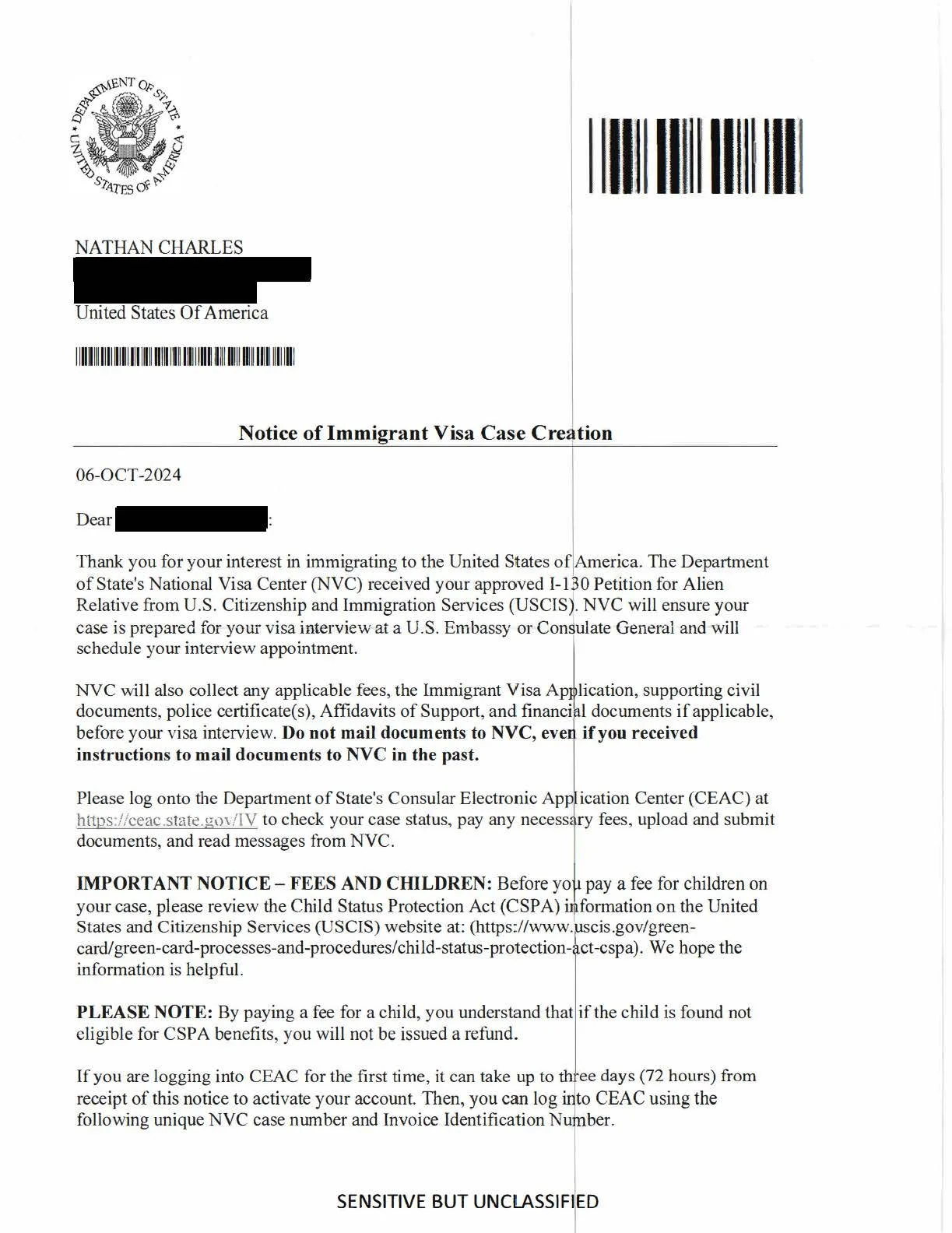
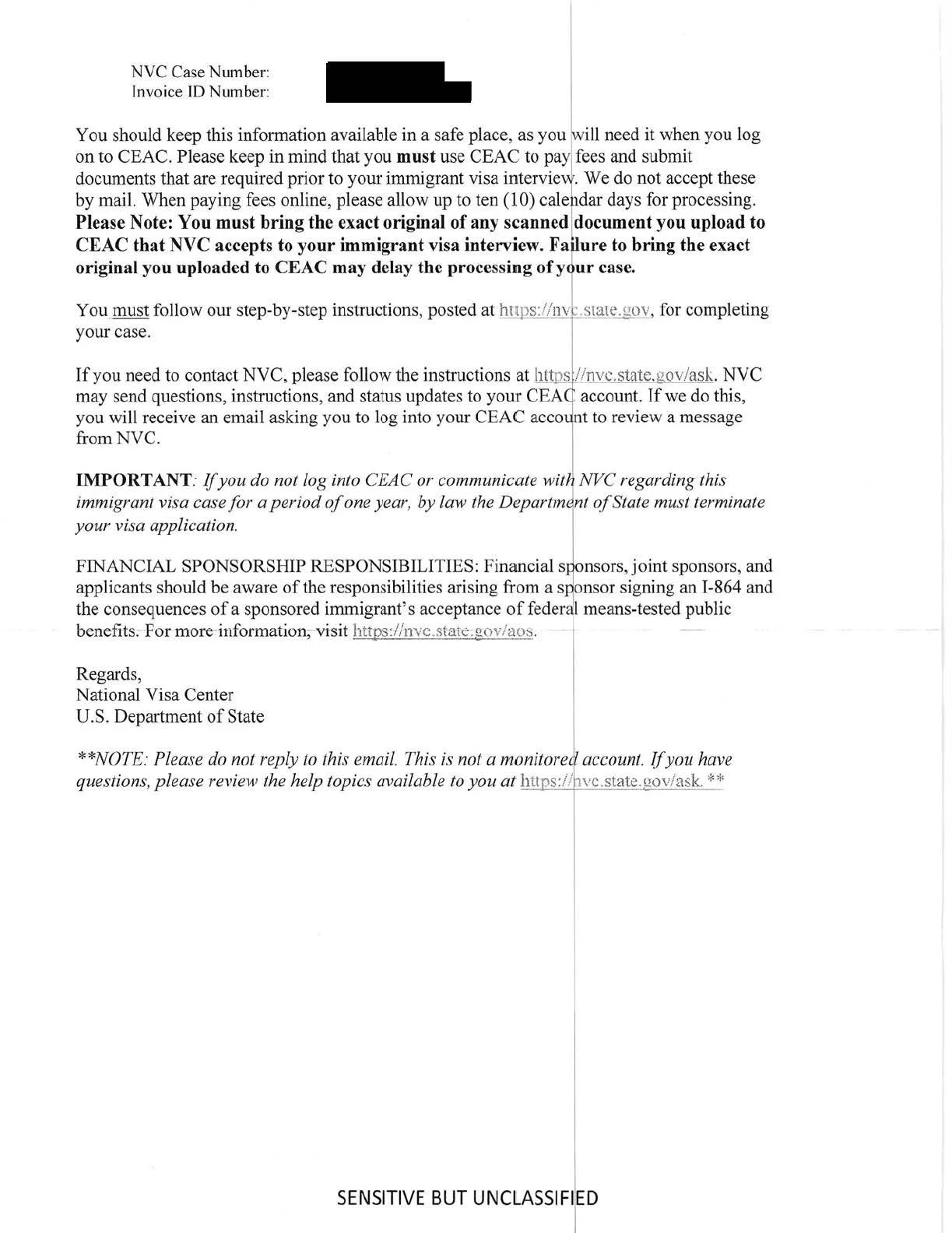
The images above show a typical NVC Case Creation Letter; details may vary.
Step-by-Step: Creating a CEAC Account and Logging In
CEAC is the State Department’s portal for immigrant visa processing and DS-260 submission.
Step 1 — Go to CEAC and choose the immigrant visa application area
You will be prompted for your Case Number and Invoice ID Number from your NVC Case Creation Letter.
Step 2 — Select your role
CEAC allows entry as different roles (for example, applicant or attorney/agent). Select the role consistent with your case and representation.
Step 3 — Sign in and reach the case summary page
After successful login, you’ll reach a case summary page showing the DS-260 and related steps. (The DS-260 sample PDF shows what these pages look like. DS-260-Exemplar)
If you get locked out or timed out: stop, document what happened, and re-log carefully. Repeated failed attempts can worsen access issues.
Important: CEAC Is Unstable — Plan Accordingly
The Consular Electronic Application Center (CEAC) is notoriously difficult to work with. It is not user-friendly, and it does not behave like a modern web application. You should plan for that reality before you begin the DS-260.
Key points to keep in mind:
CEAC times out quickly.
If you are inactive for even a short period, the system may log you out without warning.
Save your work frequently. Do not assume the system will preserve unsaved entries.Draft your answers offline first.
Many applicants find it helpful to write out their DS-260 answers in advance in:a Word document, or
an empty email draft
You can then copy and paste your prepared responses into CEAC. This significantly speeds up data entry and reduces the risk of losing work due to timeouts.
Avoid repeated logins over a short span of time.
CEAC has security features that may temporarily block access if you log in too many times from the same IP address in a short period. When this happens, you may be unable to access CEAC at all for a period of time.If you are temporarily blocked, patience is often required.
In some cases, access restores itself after waiting. In others, accessing CEAC from a different network or IP address may be necessary. In an emergency, try using a VPN to log in from a different geographic location.
Bottom line:
Treat CEAC as fragile. Work deliberately, save often, prepare your answers in advance, and avoid unnecessary logins. These steps alone can prevent hours of frustration and unnecessary delays.
How the DS-260 Is Organized
The DS-260 is broken into sections. The exact flow can vary slightly by case type and answers, but the major sections include:
Getting Started / Summary
Personal Information (names, DOB, place of birth, nationality)
Passport and travel document details
Address and contact history (including phone/email history and social media identifiers)
Family information (parents, spouse, prior spouses, children)
Prior U.S. travel
Work / education / training history
Petitioner information
Security and background questions
Social Security number questions
Review, sign, and submit
If You Are Working With an Attorney: What to Have Ready
Even when a client completes the DS-260 themselves, attorney review is only as good as the information provided. Before you begin, gather the items below so your answers match your records.
Document Checklist for DS-260 (Gather Before Data Entry)
Bring together scans plus originals (for interview). If a document is not in English, obtain a certified translation.
Identity and civil status
Passport (biographic page) and prior passports if relevant
Birth certificate (long-form)
National ID card (if issued)
Any name-change documentation
Marital history (current and all prior)
Marriage certificate(s)
Divorce decree(s) / annulment decree(s)
Death certificate(s) of prior spouse(s), if applicable
Children (all children, whether immigrating or not)
Birth certificate for each child
Adoption decrees and custody documents (if applicable)
Police and court records
Police certificates for all required jurisdictions (commonly: every country lived in for 6+ months after age 16, plus country of nationality and current residence)
Court dispositions for any arrest/charge/conviction (including dismissed/expunged matters)
Prison records (if applicable)
Military service (if applicable)
Military service record / discharge papers
Unit, dates of service, rank (supporting documentation)
U.S. immigration history (if applicable)
Copies of prior U.S. visas
Entry/exit documentation (old passports, I-94s if available)
Prior refusal, overstay, removal, or status violation documentation, if any
Financial sponsorship (commonly needed later in NVC processing)
Affidavit of Support materials (I-864 package, if applicable)
Sponsor’s tax documents and proof of status (citizen/LPR)
Click here for more information on financial sponsorship supporting immigrant visa applications.
Information Checklist for DS-260
Many DS-260 questions require accurate history, not just paperwork. Before you begin, prepare:
Names and identity details
Full name as shown in passport
Full name in native alphabet (if applicable)
All other names ever used (maiden, religious, aliases, professional names)
Address and contact history
Current address and move-in date
All prior addresses since age 16 (with dates)
All phone numbers used in the last 5 years
All email addresses used in the last 5 years
Social media platforms and usernames used in the last 5 years
Family information
Parents’ full names, dates/places of birth, and current location (or best-known)
Spouse details and marriage date/place
Prior spouse details and how/when each marriage ended
Children’s full details (including non-immigrating children)
Travel and immigration history
Prior U.S. travel dates and visa types
Any overstays or immigration violations (U.S. or other countries)
Any visa refusals in any country
Work, education, and training
Current employment details (employer, address, duties, start date)
Work history (chronological, with dates)
Education history (schools, degrees, dates)
Military service details if any
Security and background readiness
If any “Yes” answers apply, prepare a short, accurate explanation and collect supporting records before submission. Do not improvise.
Common Mistakes That Cause Delays
Using different spellings of names across passport, birth certificate, and DS-260
Missing prior marriages or children (including non-immigrating children)
Address/employment date gaps
Underreporting prior U.S. travel or visa refusals
Answering “No” to a security/background question that should be “Yes,” then trying to fix it later
Charles International Law Client Intake Link (DS-260 Pre-Entry Questionnaire)
Charles International Law Client Intake Link (DS-260 Pre-Entry Questionnaire)
To expedite DS-260 preparation, Charles International Law clients should complete our DS-260 pre-entry questionnaire. This collects the exact data we need to populate and/or review the DS-260 efficiently.
Note: Submit accurate information only. If you are unsure about dates or details, flag it clearly so we can resolve it before submission.
Next Steps After DS-260 Submission
After you submit the DS-260, you should:
Save a copy of the DS-260 confirmation page
Continue with NVC document collection and uploads as required
Prepare for the medical exam (panel physician) and interview requirements
Coordinate with counsel regarding any “Yes” answers in security/background sections
Do You Need Help With Consular Processing or the DS-260?
Consular processing and the DS-260 immigrant visa application can be confusing, time-consuming, and stressful, especially when so much depends on getting it right the first time.
The CEAC system itself is difficult to use, unforgiving of mistakes, and prone to timeouts and access issues. On top of that, the DS-260 is a sworn application. Inconsistent answers, missing history, or poorly explained “yes” responses can lead to delays, administrative processing, or requests to unlock and correct the application—sometimes months later.
Many applicants can complete parts of the DS-260 on their own. But going it alone is not always the safest or most efficient option, particularly if your case involves:
prior U.S. travel or visa refusals
prior arrests or immigration violations
multiple marriages or complex family histories
military service or work in sensitive fields
tight timelines or family separation concerns
Working with trained immigration attorneys can significantly reduce risk.
An experienced attorney helps ensure your answers are accurate, consistent with your documents, and framed in a way that minimizes avoidable problems at the NVC and consular interview stages.
If you would like help with:
DS-260 strategy and review
Consular processing from NVC through interview
Identifying and addressing red-flag issues before submission
. . . we invite you to schedule a consultation with Charles International Law.
Frequently Asked Questions About the DS-260 and Consular Processing
1. What is the DS-260 immigrant visa application?
The DS-260 is the U.S. Department of State’s online immigrant visa application used in consular processing. It is completed through the Consular Electronic Application Center (CEAC) after a case is created at the National Visa Center (NVC). The DS-260 collects biographic information, family history, address and employment history, prior U.S. travel, and security-related information, and it is submitted under penalty of perjury.
2. Where do I file the DS-260?
The DS-260 is filed online through the Consular Electronic Application Center (CEAC). You cannot file it by mail or email. Access requires your NVC case number and invoice ID number.
3. When should I complete the DS-260?
You should complete the DS-260 only after your immigrant visa case has been created at the National Visa Center and you have received the required login credentials. In most cases, it is best to gather all required documents and information before starting, rather than attempting to complete the form in multiple rushed sessions.
4. Is the DS-260 difficult to complete?
For many applicants, yes. The DS-260 is long, highly detailed, and unforgiving of inconsistencies. The CEAC system itself is prone to timeouts, limited save functionality, and access restrictions. Even minor errors can lead to delays or requests to unlock and correct the application later.
5. How long does it take to complete the DS-260?
The time required varies depending on the complexity of the case. A straightforward case may take one to two hours of data entry after preparation. Cases involving prior U.S. travel, multiple addresses, prior marriages, or security issues often take significantly longer because the information must be carefully reviewed and cross-checked.
6. What documents do I need for the DS-260?
Commonly required documents include:
A valid passport
A long-form birth certificate
Marriage, divorce, or death certificates (if applicable)
Police certificates and court records (if applicable)
Military service records (if applicable)
Prior U.S. visa and travel documentation
Not every document is uploaded with the DS-260, but your answers must match your documents exactly.
7. What information do I need even if I don’t have documents?
You should prepare:
All prior addresses since age 16
All phone numbers and email addresses used in the last five years
Social media platforms and usernames used in the last five years
Employment and education history with accurate dates
Details of all prior marriages and all children, including non-immigrating children
Incomplete or inconsistent history is a common cause of DS-260 delays.
8. Why does the CEAC website keep timing out?
CEAC is an older government system with strict session limits. If you are inactive for even a short period, the system may log you out without warning. Saving frequently and preparing your answers offline before entering them into CEAC can help prevent lost work.
9. What happens if I log in to CEAC too many times?
If you log in repeatedly within a short period, CEAC may temporarily restrict access from your IP address as a security measure. When this happens, you may be unable to access your case until the restriction clears or you access CEAC from a different network.
10. Can I save my DS-260 and come back later?
Yes, but saving is not automatic. You must manually save your work frequently. Because CEAC can time out unexpectedly, drafting answers offline first is often the safest approach.
11. What happens after I submit the DS-260?
After submission, you should save the DS-260 confirmation page. Your case will then proceed with National Visa Center document review, followed later by the medical examination and consular interview.
12. Can I correct a mistake after submitting the DS-260?
In some cases, yes—but only if the DS-260 is formally unlocked. Unlock requests can cause delays and are not always granted immediately. Preventing mistakes before submission is far easier than correcting them later.
13. Do I need a lawyer to complete the DS-260?
Not every applicant needs an attorney, but many benefit from legal guidance. Professional assistance is particularly advisable for cases involving prior visa refusals, overstays, arrests, immigration violations, military service, or complex family histories.
14. Can an attorney help even if I complete the DS-260 myself?
Yes. Many applicants complete the DS-260 themselves but ask an attorney to review the application before submission or to identify potential red-flag issues in advance.
15. How can I get help with DS-260 preparation or consular processing?
If you would like assistance with DS-260 preparation, review, or consular processing strategy, you can schedule a consultation with Charles International Law. Early guidance often reduces stress and helps avoid unnecessary delays.
Other Helpful Resources:
See Also:
CIL Guide to Family-Based Immigration Generally
CIL Guide to Employment-Based Immigration Generally
CIL Guide to Consular Processing
CIL Guide to Consular Processing at an Overseas Consulate
CIL Guide to Financial Sponsorship of Family-Based Immigrant Visa Applications
Charles International Law’s research guides are always free, but if you find them helpful, please consider a donation or gratuity.
