
Tier I, II, and III Organizations Under Terrorism-Related Inadmissibillity Grounds
Date of Information: 02/23/2026
Check back soon; we update these materials frequently.

The Terrorism-Related Inadmissibility Grounds (TRIG), codified at INA § 212(a)(3)(B), define “terrorist organization” through a three-tier framework. See INA § 212(a)(3)(B)(vi).
The tier classification is not cosmetic. It determines:
Whether formal designation exists;
Whether the organization’s terrorist status is legally conclusive;
What DHS must prove in removal proceedings;
Whether the court must conduct a threshold inquiry before analyzing respondent conduct;
How knowledge and evidentiary burdens operate in practice.
Importantly, the tier structure does not change the substantive definition of “material support.” It does, however, determine whether the immigration court must first decide that the organization qualifies as a terrorist organization before applying TRIG’s conduct-based provisions.
Understanding that sequencing is essential to litigating TRIG cases correctly.
I. Statutory Framework
INA § 212(a)(3)(B)(vi) defines “terrorist organization” in three categories:
Tier I – Organizations designated as Foreign Terrorist Organizations (FTOs) under INA § 219.
Tier II – Organizations designated under the Terrorist Exclusion List (TEL).
Tier III – Undesignated groups of two or more individuals that engage in terrorist activity.
The three tiers are structurally distinct and procedurally different.
See also 9 FAM 302.6-2(B)(2)–(3) (describing the tiered structure and post-PATRIOT Act expansion).
Tier I: Foreign Terrorist Organizations (FTOs)
Definition
Tier I organizations are those formally designated by the Secretary of State under INA § 219 as Foreign Terrorist Organizations.
Designation requires publication in the Federal Register and is based on statutory criteria, including engagement in terrorist activity and threat to U.S. nationals or national security.
Examples historically include:
Al-Qaeda
ISIS
Hezbollah
Hamas
Al-Shabaab
(Designation status changes over time; practitioners must verify current listings.)
Legal Consequences
In Tier I cases:
The designation itself is conclusive.
Immigration courts do not relitigate whether the organization qualifies.
Membership, representation, or material support triggers inadmissibility if statutory elements are met.
The government does not need to prove that the organization engaged in terrorist activity in the individual case. The designation resolves that question.
Tier II: Terrorist Exclusion List (TEL) Organizations
Definition
Tier II organizations are designated by the Secretary of State (or DHS in coordination) under the Terrorist Exclusion List authority added by the USA PATRIOT Act.
These are not FTOs under INA § 219, but they are formally designated terrorist organizations for immigration purposes.
See INA § 212(a)(3)(B)(vi)(II); 9 FAM 302.6-2(B)(2)(d)(2).
Legal Consequences
For practical purposes:
Tier II designation functions similarly to Tier I.
Immigration adjudicators do not relitigate the group’s terrorist status.
Membership and material support are analyzed against a designated entity.
Tier II designations are less common in removal proceedings than Tier I or Tier III cases.
Tier III: Undesignated Terrorist Organizations
Definition
Tier III is defined at INA § 212(a)(3)(B)(vi)(III): Any group of two or more individuals, whether organized or not, which engages in terrorist activity. No formal designation is required. No Federal Register publication is required. No prior government listing is required. This is the broadest and most litigated category in asylum proceedings.
The Breadth of Tier III
Tier III has been applied to:
Insurgent movements;
Guerrilla factions;
Resistance groups;
Ethnic militias;
Breakaway political factions;
Subgroups of larger movements.
The statute does not distinguish between:
Groups aligned with U.S. interests,
Groups later incorporated into recognized governments,
Groups opposing authoritarian regimes.
The analysis is statutory, not geopolitical.
Case Law Defining and Interpreting Tier III
Matter of S-K-, 23 I&N Dec. 936 (BIA 2006)
The BIA held that an applicant who provided funds to a Burmese opposition group was inadmissible under the material support bar, even though the group opposed a repressive regime and arguably aligned with U.S. democratic interests. The Board emphasized that:
The statutory definition controls;
There is no implied “good cause” exception;
Political sympathy does not override statutory elements.
Matter of S-K- is foundational for understanding that Tier III analysis is formalistic and not policy-driven.
Matter of A-C-M-, 27 I&N Dec. 303 (BIA 2018)
Although primarily a material support case, A-C-M- reinforces Tier III breadth. The Board held:
There is no implied duress exception;
There is no de minimis exception;
Even forced labor (cooking and cleaning under threat of death) constituted material support to a terrorist organization.
The decision illustrates how Tier III, combined with broad “material support” interpretation, produces sweeping inadmissibility consequences.
Annachamy v. Holder, 733 F.3d 254 (9th Cir. 2013)
The Ninth Circuit held:
There is no statutory duress exception to the material support bar;
The statute applies even to coerced support.
Although focused on material support, Annachamy demonstrates the rigidity of TRIG once Tier III status is established.
Khalil v. Cissna (9th Cir. 2021)
In Khalil, the issue involved whether military-type training received before a group was considered a terrorist organization could trigger inadmissibility.
The case underscores a recurring Tier III issue:
Retroactive characterization of organizations;
Temporal interpretation of “when the training was received.”
The statutory phrase “at the time” became central to the dispute.
Knowledge Requirement in Tier III Cases
INA § 212(a)(3)(B)(vi)(III) includes a knowledge safeguard:
For membership in an undesignated terrorist organization, the applicant must demonstrate by clear and convincing evidence that they did not know, and should not reasonably have known, that the organization was a terrorist organization.
See also 9 FAM 302.6-2(A)(6). This is often the decisive issue in Tier III litigation.
In designated Tier I and II cases, knowledge of formal designation is generally irrelevant. In Tier III cases, knowledge is a statutory element.
Common Tier III Contexts
Tier III cases frequently arise in:
Civil wars,
Insurgencies,
Regions controlled by armed non-state actors,
Fragmented resistance movements,
Situations involving de facto local authorities.
Because Tier III does not require formal designation, DHS may rely on country conditions evidence, historical records, expert testimony, and other documentation to establish that a group engaged in terrorist activity.
The absence of designation makes Tier III cases fact-intensive and often complex.
II. The Critical Threshold Difference
The tier structure does not create a formal burden-shifting regime. However, it does alter what DHS must establish before the court may apply TRIG’s conduct-based provisions.
Tier I and Tier II: Organizational Status Is Established
In Tier I and Tier II cases:
The organization’s terrorist status is established by designation.
The court proceeds immediately to respondent-specific conduct.
In a material support case, DHS must establish:
The identity of the organization;
That it is designated (Tier I or II);
That the respondent provided material support;
That the respondent knew or reasonably should have known their act afforded material support to a terrorist organization.
The character of the organization itself is not litigated.
Tier III: A Mandatory Organizational Inquiry
In Tier III cases, designation does not resolve the issue.
Before the court may apply the material support bar, DHS must establish that:
The group consisted of two or more individuals; and
The group engaged in “terrorist activity” as defined in INA § 212(a)(3)(B)(iii).
If DHS fails to establish that the organization qualifies under Tier III, the TRIG charge premised on that organization fails. Only after this threshold determination does the court proceed to respondent-specific conduct. This sequencing is often outcome-determinative.
III. Application to Material Support
The substantive definition of “material support” under INA § 212(a)(3)(B)(iv)(VI) is the same across all tiers.
Courts and the Board of Immigration Appeals have interpreted the provision broadly, including:
No implied duress exception;
No de minimis exception;
A wide understanding of what constitutes assistance that “affords material support.”
That analysis does not change depending on tier.
What changes is whether the court must first determine that the organization qualifies as a terrorist organization (Tier III), or whether designation has already resolved that question (Tier I and Tier II).
In summary:
Tier I / Tier II → Designation established → Move directly to material support analysis.
Tier III → Prove organization engaged in terrorist activity → Then analyze material support.
The Tiers and Material Support: Not Quite a Burden-Shifting Framework — But Close
It is tempting to describe the tier structure as creating a burden-shifting regime. That description would be imprecise. The statutory burdens are set by INA § 240(c) and specific TRIG provisions. The tiers do not formally reallocate those burdens.
But as a practical matter, the tiers determine who must produce what evidence — and in what sequence — before the court reaches the material support analysis.
In Tier I and Tier II cases, DHS does not need to prove that the organization engaged in terrorist activity. The designation resolves that element. The case turns immediately to the respondent's conduct and knowledge.
In Tier III cases, DHS must first establish that the group qualifies as a terrorist organization by proving the statutory elements of organizational structure and terrorist activity. Only after that showing does the court evaluate material support and any applicable knowledge defenses.
For Tier III material support, the statute allows the respondent to demonstrate, by clear and convincing evidence, that they did not know, and should not reasonably have known, that the organization was a terrorist organization. That burden arises from the statute itself — not from the tier framework.
The result is not true burden-shifting, but a tier-dependent sequencing of proof that can be decisive in litigation.
IV. Analytical Framework for Applying TRIG to Material Support: A Tier-Dependent Sequencing Model
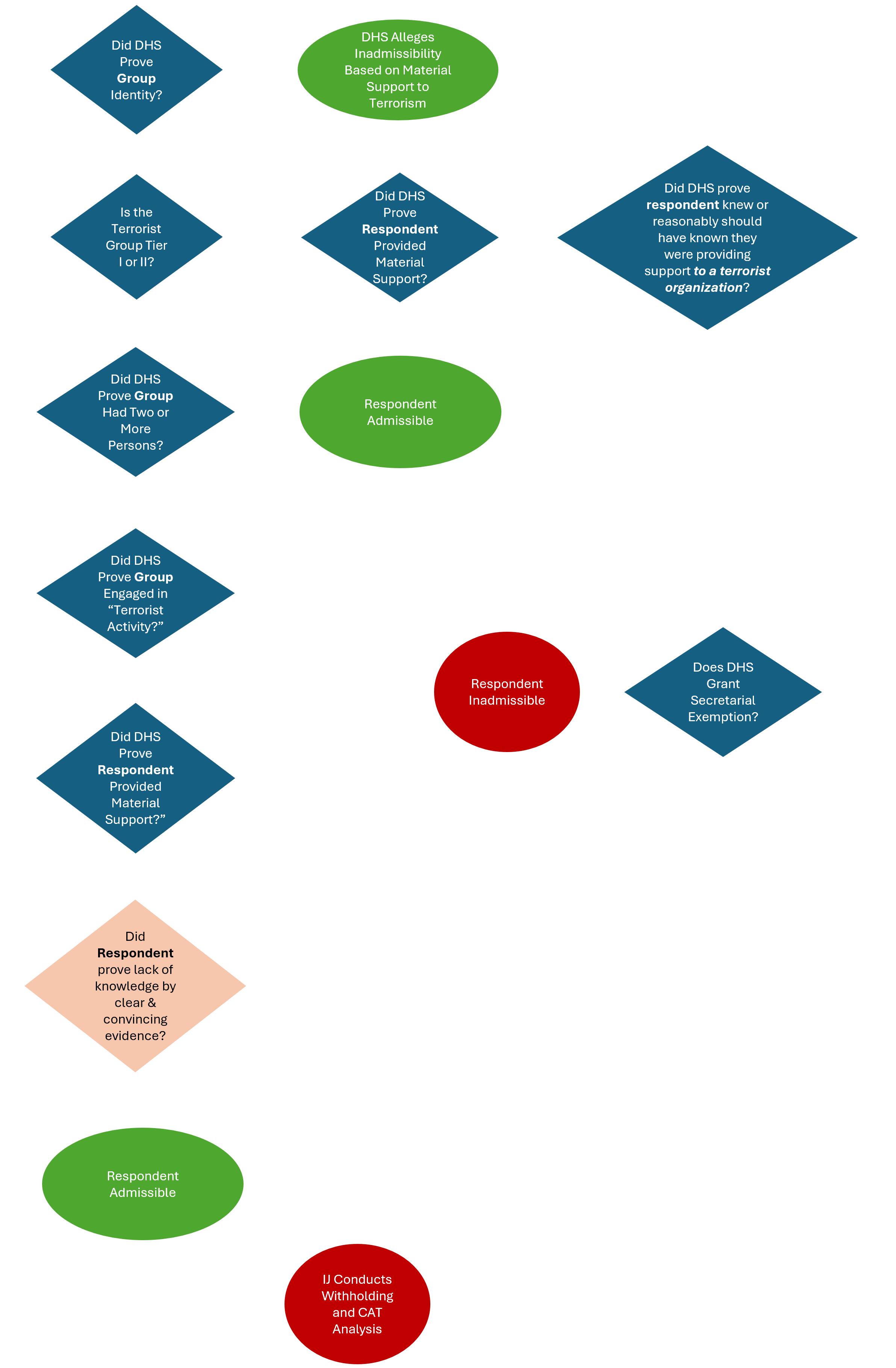
This flowchart illustrates how the tier classification of a terrorist organization determines the order in which statutory elements must be established before a finding of inadmissibility may be made under the material support provision of INA § 212(a)(3)(B)(iv)(VI). In Tier I and Tier II cases, formal designation conclusively establishes the organization’s terrorist status, and the inquiry proceeds directly to whether DHS has proven that the respondent provided material support and possessed the required knowledge. In Tier III cases, by contrast, DHS must first prove that the group consisted of two or more persons and engaged in “terrorist activity” within the statutory definition before the court may analyze respondent-specific conduct. Only after those threshold elements are satisfied does the material support inquiry proceed, including the respondent’s opportunity—where statutorily applicable—to demonstrate lack of knowledge by clear and convincing evidence. The diagram, therefore, reflects not a true burden-shifting regime, but a tier-dependent allocation and sequencing of proof that can be outcome-determinative in TRIG litigation.
V. Secretarial Exemptions and Tier Distinctions
Even where inadmissibility is established, DHS may exercise discretionary exemption authority under INA § 212(d)(3)(B)(i).
Important structural points:
Immigration Judges cannot grant TRIG exemptions.
Exemptions are discretionary and policy-driven.
If no exemption is granted and asylum is barred, the court must still analyze withholding of removal and CAT protection where applicable.
VI. Strategic Considerations
When TRIG exposure is possible, counsel should determine at the outset:
Which tier classification applies?
Is DHS relying on formal designation or alleging Tier III status?
What evidence supports organizational qualification (if Tier III)?
What specific conduct is alleged?
How does the knowledge element operate in the case?
Is exemption relief realistically available?
Misidentifying the tier classification can distort the entire litigation strategy.
TRIG Exposure Is Structural, Not Situational
If DHS raises a terrorism-related inadmissibility ground, the case is no longer just about what happened — it is about how the statute is structured. Tier classification, threshold proof, knowledge elements, and exemption pathways can determine the outcome before the merits of an asylum claim are ever reached. These cases require disciplined statutory analysis, careful evidentiary strategy, and a clear understanding of how immigration courts sequence TRIG determinations. If you or a client may be facing a terrorism-related inadmissibility issue, early, informed intervention is critical.
Frequently Asked Questions
1. What is the difference between Tier I, Tier II, and Tier III terrorist organizations under U.S. immigration law?
Tier I organizations are formally designated Foreign Terrorist Organizations (FTOs) under INA § 219. Tier II organizations are designated under separate Terrorist Exclusion List authority. In both cases, designation conclusively establishes terrorist status in immigration proceedings. Tier III organizations are not formally designated; instead, DHS must prove that the group consisted of two or more individuals and engaged in “terrorist activity” as defined in INA § 212(a)(3)(B)(iii). Tier III is the broadest and most litigated category in asylum and removal cases.
2. Does the tier classification change the definition of “material support”?
No. The substantive definition of “material support” under INA § 212(a)(3)(B)(iv)(VI) is the same across all tiers. Courts and the Board of Immigration Appeals have interpreted the term broadly. What changes is whether DHS must first prove that the organization qualifies as a terrorist organization (Tier III) before the material support analysis begins.
3. In a Tier III case, what must DHS prove before material support is analyzed?
DHS must establish that the group consisted of two or more persons and that it engaged in “terrorist activity” within the statutory definition. Only after that threshold showing does the court evaluate whether the respondent provided material support or falls under another TRIG provision.
4. Does DHS have to prove that a Tier I or Tier II organization engaged in terrorist activity in my case?
No. For Tier I and Tier II organizations, formal designation resolves the organizational question. Immigration courts treat the terrorist status of the organization as established by law and move directly to respondent-specific conduct and knowledge.
5. What does “knowledge” mean in a material support case?
For material support to a designated (Tier I or II) organization, DHS must prove that the respondent knew or reasonably should have known they were providing support to a terrorist organization. In Tier III cases, the statute provides that a respondent may demonstrate, by clear and convincing evidence, that they did not know and should not reasonably have known that the organization was a terrorist organization. The precise allocation depends on the specific TRIG ground alleged.
6. Is there a duress exception to the material support bar?
The statute does not contain an implied duress exception. Courts have interpreted the material support provision broadly. Relief in duress scenarios generally depends on discretionary Secretarial exemption authority rather than a judicially recognized statutory exception.
7. What kinds of groups can qualify as Tier III organizations?
Tier III can include insurgent movements, guerrilla factions, militias, resistance groups, or other non-state actors that engage in conduct meeting the statutory definition of “terrorist activity.” No formal designation is required, which is why Tier III cases often involve detailed country-conditions evidence and fact-intensive litigation.
8. If I am found inadmissible under TRIG, is all relief automatically barred?
Not necessarily. A TRIG finding may bar asylum and certain forms of adjustment, but the immigration court must still analyze eligibility for withholding of removal and protection under the Convention Against Torture (CAT), where applicable. Additionally, DHS may exercise discretionary Secretarial exemption authority in certain circumstances.
9. Why does the tier classification matter so much in asylum cases?
Because the tier determines what DHS must prove before inadmissibility attaches. In Tier I and II cases, designation resolves the organizational issue. In Tier III cases, DHS must first prove that the group engaged in terrorist activity. That threshold determination can be decisive in litigation.
10. Can the immigration judge grant a TRIG exemption?
No. Immigration Judges do not have authority to grant Secretarial exemptions under INA § 212(d)(3)(B)(i). Exemptions are discretionary decisions made by DHS (often in consultation with the Department of State and the Attorney General). If no exemption is granted and asylum is barred, the court proceeds to withholding and CAT analysis where appropriate.
Other Helpful Resources:
See Also:
CIL Guide to the Circumvention of Lawful Pathways Rule
Charles International Law’s research guides are always free, but if you find them helpful, please consider a donation or gratuity.
